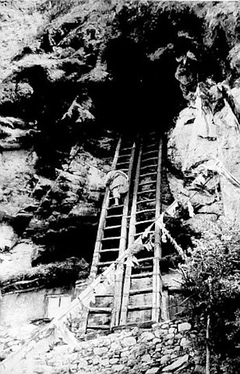
Drak Yangdzong Praise
The Thousand-Spoked Dharma Wheel of Auspiciousness[1]
A Brief Praise of the Sacred Site of the Awakened Body
by Jokyab Pema Trinlé Nyingpo
Guided by Mañjuśrīmitra, heart disciple of Loden Choksé,[2]
Who received the mandate to practice Mañjuśrī Yamāntaka at the sacred site of Drak,
Renowend as Sangyé Yeshé, born into the Nub clan—
Mahāsiddha, who bound sun and moon as his throne, you I recall.
Outwardly, a fearsome charnel ground, a realm of terror;
Inwardly, a naturally arisen palace for accomplishing the Three Roots;
Secretly, Akaniṣṭha itself, the Vajra Queen’s expanse of É—
To Drak Yangdzong, king of all practice places, I pay homage!
The wheel of the abiding ground is the realization of the three kāyas.[3]
The wheel of existence, dualistic grasping, is the illusory appearance of the three poisons.
The wheel of wisdom that tames is the awakened activity throughout past, present, and future.
The wheel of emanated skillful means for taming is the wondrous display of the three secrets.
Turning to oneself, one realizes the meaning of self-arising wisdom.[4]
Turning to others, those connected to us are set upon the path to liberation.
Turning to both, dualistic grasping is freed into non-duality.
Not turning to anything is the wheel of total purification of the three spheres.
The conduct, discipline and learning, is the hub[5] of training in perfect discipline.
The meditation, gaining mastery, is the rim of training in meditation.
The view, free from extremes, is the thousand spokes of training in wisdom—
May the result, the Dharma wheel of the three trainings, turn in all directions!
The wheel of the generation stage is the peaceful and wrathful deities of the three seats.[6]
The wheel of the recitation stage is the vajra recitation of three syllables of prāṇāyāma.
The wheel of the completion stage is the wisdom of the three times and timelessness—
May the wheel of deity, mantra and Dharma turn without interruption!
The wheel of enlightened body encompasses the major and minor marks—outer, inner, and secret.
The wheel of enlightened speech is the teachings of the three piṭakas.
The wheel of enlightened mind is knowledge of the threefold wisdom.
May the wheel spontaneously accomplishing the twofold benefit be all-pervasive and everlasting!
This prayer of aspiration was recently composed by Pema Trinlé Nyingpo, who is devoted to Guru Mañjuśrī in both peaceful and wrathful forms, following the auspicious completion of a feast offering in the maṇḍala of Drak Yangdzong, at the long-standing request of the supreme tulku.
| Samye Translations (trans. Stefan Mang), 2026.
Bibliography
Tibetan Edition
jo skyabs padma ʼphrin las snying po. “sku yi dben gnas la zur tsam bsngags pa bkra shis rtsibs stong rnam par bkra ba'i dharma tsakra.” gsung ʼbum padma ʼphrin las snying po. Edited by Karma bde chen. Vol. 1. gzu dgon rig gzhung nyams gso khang, 2010: 26–28.
Version: 1.0-20260212
-
The author composed a praise for each of the accomplishment sites of the eight Kagyé deities, with each praise named after one of the Eight Auspicious Symbols. ↩
-
Here the author establishes a lineage of accomplishment linking the vidyādhara who first revealed the respective Kagyé deity, Guru Padmasambhava—who subsequently accomplished that same deity while manifesting in a form corresponding to it—and the original Tibetan disciple who realized the practice. ↩
-
An outline of the four wheels related to the practice of Yamāntaka (‘jam dpal gyi sku ‘khor lo bzhi). ↩
-
The verb 'turning' is used to continue the wheel metaphor. ↩
-
Here, view, meditation and conduct are each equated with a component that together forms a wheel. ↩
-
Often referred to as the maṇḍala of the three seats of completeness. The three seats are: (1) the aggregates (skandha) and elements (dhātu); (2) the sense fields (āyatana); and (3) limbs (aṅga). In the first reside the tathāgatas, in the second reside the male and female bodhisattvas, and in the third reside the male and female wrathful deities. ↩